
The first tenant model on my EKS reference platform did not survive its first end-to-end run. CI aimed a tenant’s Argo CD Application at kube-system, and Argo CD did not refuse it (run 38258884777, 12 October 2026).
The design was the one many shared clusters start with. One Argo CD project for every tenant, every namespace allowed, and the platform’s own namespaces denied by pattern: !kube-*, !argocd, and so on. It reads as a guardrail, and it is only as complete as the memory of whoever wrote it.
This is the model that replaced it, how a team gets onto the platform with one pull request, and how each wall around that team is checked by a test that has watched it fail.
Three designs in one day
The kube-system escape was the first gap, and the cheapest to find, because the e2e suite was written to try it. Two more came out of a security review of the same work, the same day.
Each tenant wrote its own Namespace. Every admission policy on the platform keys on a tenant label on that Namespace, so a team could drop the label, set Pod Security to privileged, and run what it liked. The namespace’s labels were the guardrail, and the team owned them.
The second draft gave each tenant its own project and refused dangerous kinds by name. The review found the kind nobody had listed: a RoleBinding that makes the team admin of its own namespace. Kubernetes’ built-in admin role reads and writes most resources in a namespace, Secrets included, and creates Roles and RoleBindings there. Bound to an account the team’s pods run as, it lets the team write through the API the kinds its project refuses, outside Argo CD entirely.
Every gap was something nobody had put on a list. The fix was to stop keeping lists of what is forbidden.
What a team writes, and what it never writes
Onboarding is one directory. A team copies the template, or runs the plugin that does it and refuses a reserved name before it writes anything:
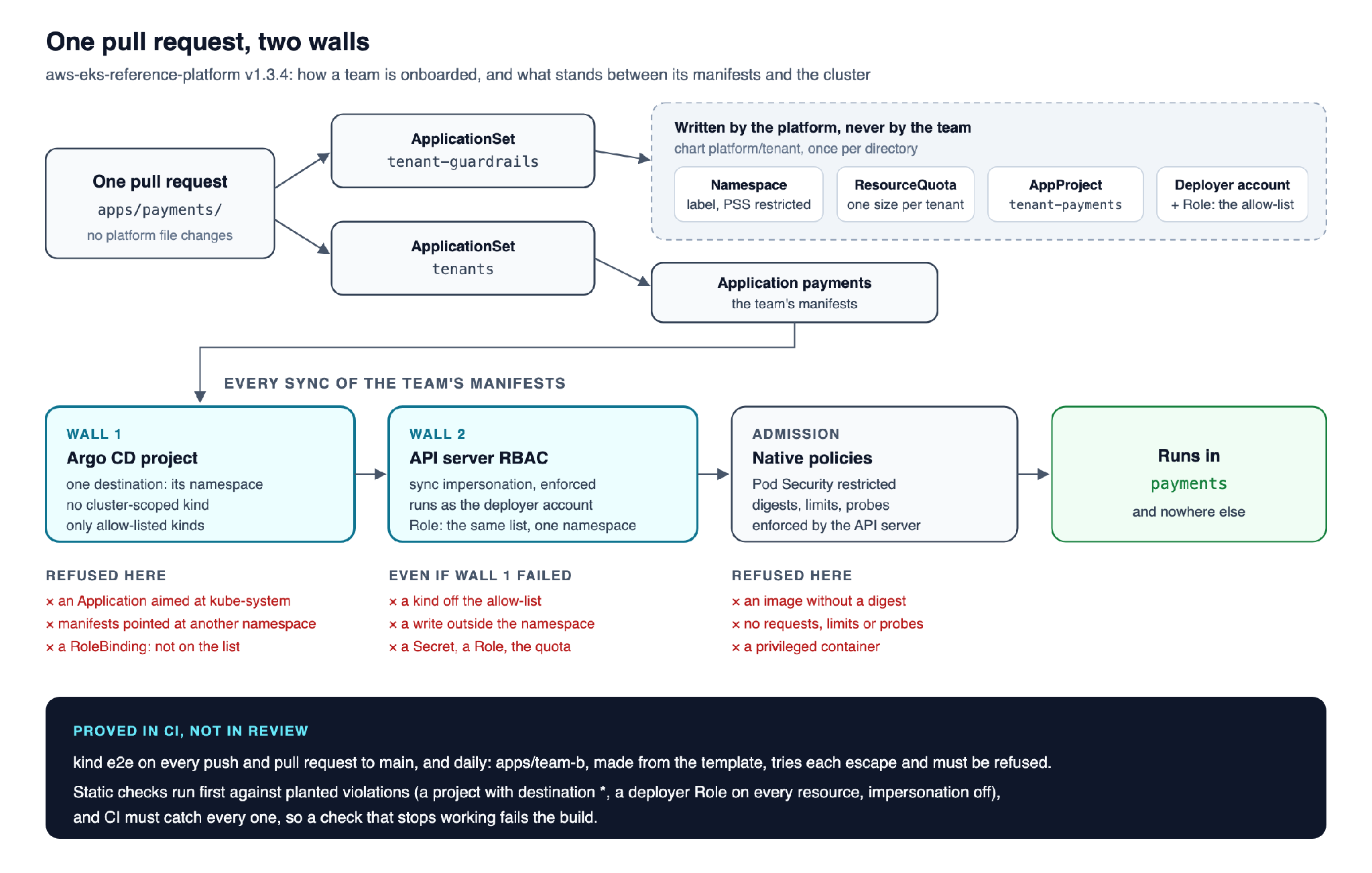
The pull request adds apps/payments/ and changes no platform file. Before review, kubectl tenant check payments reports from the files alone what admission would refuse: an image without a digest, missing requests or memory limit, missing probes, a privileged container.
Two ApplicationSets read the same directory. One deploys the team’s manifests. The other installs a small chart the platform owns, once per tenant: the Namespace with its tenant label and Pod Security restricted, a ResourceQuota, and an Argo CD project named tenant-payments. The team’s directory holds only what runs inside the namespace. The namespace itself is never the team’s to write.
A directory name becomes a namespace, a project and an Application, so apps/kyverno would otherwise take a platform namespace. The chart refuses the platform’s names, plus anything starting with kube- or tenant-, and a CI check fails when a platform namespace is missing from that reserved list.
Wall one: a project per tenant, allow-list only
Each tenant’s project has one destination, the team’s namespace. It takes manifests from the platform repository only, allows no cluster-scoped kind, and allows only the namespaced kinds a service needs. An excerpt of the chart’s template at v1.3.4 (platform/tenant/templates/project.yaml):
The list covers workloads, Services, ConfigMaps, volumes, routes, network policies, ExternalSecrets and monitoring objects. Role and RoleBinding are not on it, and neither are Secret, SecretStore, ResourceQuota, LimitRange, Kyverno policies and exceptions, or Gateway. A kind nobody has thought about yet is refused until someone adds it in a platform change, reviewed as one.
Wall two: the sync runs with the tenant’s rights
A project is Argo CD’s opinion. The API server does not read it. So the second wall is Kubernetes RBAC, applied to the sync itself through Argo CD’s sync impersonation, a beta feature since Argo CD 3.5, switched on and enforced in argocd-cm (platform/values/argo-cd/common.yaml at v1.3.4):
With enforcement on, a project that names no account cannot sync at all. A tenant’s syncs run as tenant-payments-deployer, a ServiceAccount in the argocd namespace, where no tenant pod can mount it. Its Role grants exactly the allow-listed kinds, in the tenant’s namespace, and nothing anywhere else. The platform’s own projects name the controller’s account explicitly.
If the project is ever written wrong, the API server still answers forbidden. One mistake is no longer enough.
Proved, not reviewed
apps/team-b was made from the template and is kept as the proof. The kind e2e suite runs on every push and pull request to main and once a day, both on a fresh install and on an upgrade from the previous release. In the scheduled run of 16 November 2026, the tenant section checked that:
- team-b answers on its own route and got its own generated default-deny;
- team-b cannot read the demo tenant’s secret through the platform store;
- its project refuses an Application aimed at
kube-system, its manifests pointed at thedemonamespace, and a RoleBinding that would make it admin of its namespace; - its syncs run as an account the API server limits to the allow-list in team-b;
- its namespace and quota are tracked by
tenant-team-b, the platform’s Application, not by the team.
The last ten scheduled runs, 7 to 16 November, passed. Before any of that, the static checks run against planted violations: a tenant project whose destination is *, a deployer Role that grants every resource, impersonation switched off, a tenant syncing as the controller’s own account, a reserved name dropped from the list, a team-b manifest pointed at the demo namespace. CI must catch every one, so a check that stops working fails the build instead of passing quietly.
A guardrail nobody has seen refuse something is an assumption.
What it costs
The model has a price, and the decision record states it.
- Impersonation is beta. Enforcing it means the bootstrap creates the projects before the root Application, and a new project that forgets
destinationServiceAccountscannot sync. The CI check refuses one in review. - A team that needs a kind off the list, a Role for a controller of its own for example, gets
forbiddenon sync until a platform change adds it. That wait is the point. - Every tenant gets the same quota: 2 CPUs and 4 GiB of memory requested, 8 GiB of memory limits, 50 pods, 10 volumes, 50 GiB of storage, and no LoadBalancer or NodePort Service. Per-team sizes are a values file away when the second team asks.
- Secrets are not shared by default. On EKS, a tenant that needs them gets its own store and its own Pod Identity role scoped to its prefix, a Terraform change per team. The friction sits on the one mistake that cannot be taken back.
- Removing a directory deletes both Applications and leaves the namespace, because neither carries Argo CD’s resources finalizer. A merge never deletes a team’s data.
Two risks stay open, and the platform’s threat model lists both. The platform’s own Applications still sync with the controller’s cluster-wide rights, because the platform installs cluster-scoped add-ons, so whoever can push to the platform repository controls the platform, and its branch protection is part of every tenant’s boundary. And the tenant walls are proved on kind: the scheduled run on a real AWS account checks admission, IMDSv2, certificates, Karpenter and Velero, not the walls, and the IAM scoping that keeps a cloud role to one namespace is checked against a mocked Terraform plan.
It also has an edge. At dozens of teams, a namespace-as-a-service controller such as Capsule earns its keep. For regulated or hostile tenants, a cluster per tenant is still the answer. This model is for teams of one organization sharing one platform.
The part that scales
The platform team reviews a one-directory diff in minutes, because nothing dangerous in it depends on the reviewer noticing. The project refuses it, the API server refuses it, or admission refuses it, and CI shows each refusal working every day.
Review attention does not grow with the number of teams. A refusal that CI has watched fail keeps working whether anyone is looking or not.
Sources: aws-eks-reference-platform at v1.3.4, ADR 12, the onboarding guide, the failed run of 12 October 2026, the scheduled run of 16 November 2026, Argo CD sync impersonation.