

The AI hype cycle has reached a critical inflection point. Enterprises rushing to adopt AI are discovering that success has little to do with which model they choose - and everything to do with how they integrate AI into existing infrastructure. This post cuts through the noise to focus on what platform engineers actually need to know about building production-ready AI systems.
Main insights
- Platform engineering principles don't change with AI - you already have 80% of what you need
- AI is just another workload - treat it like any other production system with proper operational discipline
- The infrastructure around the model (caching, tools, permissions, serving) is inseparable from the model itself
- Integration with existing data, security, and development pipelines determines success more than model selection
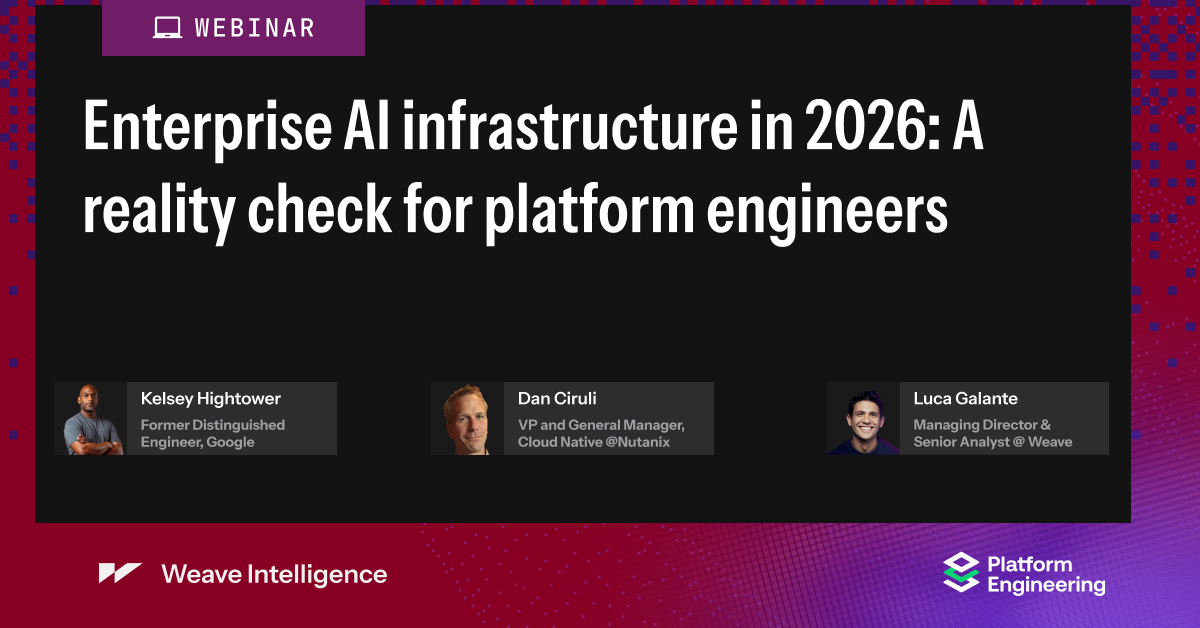
This conversation brought together two voices who need little introduction in the platform engineering world. Kelsey Hightower, Author and retired Distinguished Engineer, has spent decades solving infrastructure problems - from system administration to Kubernetes advocacy at Google. Dan Ciruli, VP and General Manager of Cloud Native at Nutanix, brings deep experience from his work on cloud native technologies and platform engineering practices. Together, they offer a grounded, practitioner-focused perspective on what enterprise AI infrastructure actually looks like in 2026.
You can watch the full discussion here if you missed it.
AI is just another workload (but the infrastructure is the model)
Kelsey opened with a perspective that challenges much of the current AI discourse: "AI is just another workload." This isn't dismissive - it's liberating. When you frame AI this way, the operational discipline and infrastructure patterns you've built over the past 15 years become directly relevant again.
There's a critical nuance, though. As Kelsey explained, "The infrastructure is the model. You can't just take a model without all the caching layers. You can't take a model with all the lookups that it does under the hood." When enterprises evaluate AI systems, they're not just evaluating weights and parameters. They're evaluating an entire stack that includes:
- Caching mechanisms that dramatically affect performance and cost
- Tool calling interfaces that determine what the model can actually do
- Data retrieval systems that provide context at inference time
- Permission boundaries that control access to sensitive resources
- Serving infrastructure that handles scale and reliability
Dan reinforced this from an enterprise perspective: "Integration is carrying a lot of weight here because integration means how is it going to integrate with your data. If your AI doesn't have access to your data, you're in trouble." Most enterprises are still at step zero or step one - individuals using tools like Claude or ChatGPT - without systematic integration into production systems. Closing that gap is where platform teams earn their value.
The platform engineering role is evolving, not being replaced
One of the most reassuring messages for platform engineers came from Kelsey's historical perspective. "We've been through this so many times," he noted, referencing adoption curves for databases, HTTP servers, containers, and big data. Each wave brought similar concerns about specialized hardware, new operational patterns, and integration challenges. Each time, platform engineers adapted and absorbed the new workload.
Dan drew a clear line between experimentation and platform engineering: "Platform engineering is not about experimentation. Platform engineering is about taking the results of that experimentation - saying okay, now we've decided, we know, here's the thing we can speed up our time to build, test, or fix a bug - now we need to put it in production across our company."
That means platform teams must:
- Build automation to deploy AI workloads consistently and repeatably
- Implement security controls that don't rely on individual developers making the right call
- Create golden paths - paved roads that make it easy to do the right thing by default
- Establish observability and governance across all AI systems
The discussion also surfaced a notable trend: platform teams are now receiving inbound requests not just from engineering, but from marketing, legal, and sales teams who have experimented with AI tools and need them productionized. Research cited in the discussion suggests roughly 43% of this responsibility is landing on platform teams - a signal that the scope of platform engineering is expanding fast.
Security and governance: Applying zero trust to agents
The most actionable segment of the discussion focused on security. Kelsey offered a sharp analogy: giving an AI agent broad credentials is like "hiring someone off the street, not knowing their name, never seeing their resume, not talking to them, just giving them a seat and handing them keys to production."
The solution isn't new - it's applying existing security principles to a new class of workload:
- Workload identity: Agents must have their own identities rather than inheriting human credentials. Concerning data from the discussion showed 30-40% of agents simply use their operator's permissions wholesale.
- Task-based permissions: Agents must receive just-in-time credentials scoped to specific tasks, not standing access to broad resources.
- Sandboxing: Agents must run in constrained environments where unauthorized actions are blocked by default, not just logged after the fact.
- Zero trust architecture: Assume everything will misbehave and limit blast radius accordingly.
Dan grounded this in familiar terms: "If your developers are allowed to just deploy random code that automatically has access to things on your network, then you're asking for trouble." The same principles that protect against malicious or buggy code apply directly to AI agents. This isn't a new problem - it's an old problem wearing a new hat.
What platform teams actually need to build
The discussion included a detailed look at what an agentic engineering platform actually requires. Moving beyond the hype, the speakers outlined three concrete infrastructure layers:
Agent-level harness: This covers execution environments, context management, evaluation frameworks, and identity systems. Platform teams must think carefully about how agents execute, what context they carry, how to evaluate their outputs, and how to manage their permissions lifecycle.
Platform-level governance: This encompasses security controls, observability pipelines, and policy enforcement that work across all AI workloads - not just individual use cases. Governance can't be bolted on per-team; it must be built into the platform itself.
Model infrastructure: This is where inference happens - whether using frontier models via API, running open-weight models on-premises, or a hybrid approach. Platform teams must support multiple models and deployment patterns, with the ability to route requests appropriately as the landscape evolves.
Kelsey was direct about model training: "For 99% of companies, the answer is no, you don't need to train a model for this. You need to choose a model for this, and you'll probably need to put in some infrastructure to make sure that you can change that model later." Portability and flexibility matter more than picking the "best" model today.
The path forward: Practice over best practices
Perhaps the most grounding message came near the end of the discussion. Kelsey reminded the audience that "most of this stuff no one's done before in production. So best practices don't exist. All we're really talking about now is practice."
That means:
- Security is being added as systems mature - protocols like MCP are still evolving
- Models are inefficient because they're version one of a new category
- Integration patterns are still being discovered through real production experience
- Teams must experiment, learn, and iterate rather than wait for a definitive playbook
Dan offered a useful timeline: "In five years this will not be the conversation because things will mature enough to just run them as another workload." The goal isn't to build "AI apps" - it's to build apps that happen to use AI, just as we stopped calling things "web apps" once HTTP became infrastructure.
For platform engineers feeling overwhelmed, Kelsey's advice was practical: "Get a whiteboard out and draw a little box around this thing called agent. Draw a little box around this thing called AI model or inference. Figure out how to rationally run it. What you're going to find is 80% of the things are roughly the same and the rest of it may need a little bit of glue and duct tape until it integrates into your existing stack."
If you enjoyed this, find more great insights and events from our Platform Engineering Community.
If you want to dive deeper, explore our instructor-led Platform Engineering Certified Professional course and connect with peers from large-scale enterprises who are driving platform engineering initiatives.
Key takeaways
- Treat AI as another workload with proper operational discipline: Apply the same rigor to AI systems that you apply to databases, web services, and other production workloads. This means proper scheduling, resource management, monitoring, and incident response - not special treatment that bypasses established practices.
- Focus on integration over model selection: Your success with AI depends more on how well you integrate with existing data sources, security systems, and development pipelines than on which model you choose. Platform teams must prioritize building robust integration patterns that can support multiple models and use cases over time.
- Apply zero trust principles to AI agents: Agents must have their own workload identities, task-scoped credentials, and sandboxed execution environments. The same security principles that protect against malicious or buggy code apply directly to AI systems - don't treat agents as a special exception.
- Build for experimentation today and production tomorrow: Platform engineering is about taking successful experiments and making them repeatable, secure, and scalable across the organization. Create the automation and golden paths that let teams move from proof-of-concept to production safely and quickly - that's where platform teams deliver the most leverage.