
Platform engineering promised to transform how organizations build and ship software. Yet 45.3% of teams cite developer adoption as their top challenge… not because of technical complexity, but cultural resistance. The data from the State of Platform Engineering Vol 4 report reveals a striking pattern. Organizational and cultural barriers consistently massively outweigh technical ones.
Platform engineering is a sociotechnical approach requiring change management, executive alignment, and product thinking. If your platform initiative is struggling, you're not alone - and the solutions are more actionable than you might think.
What the data reveals about platform engineering challenges
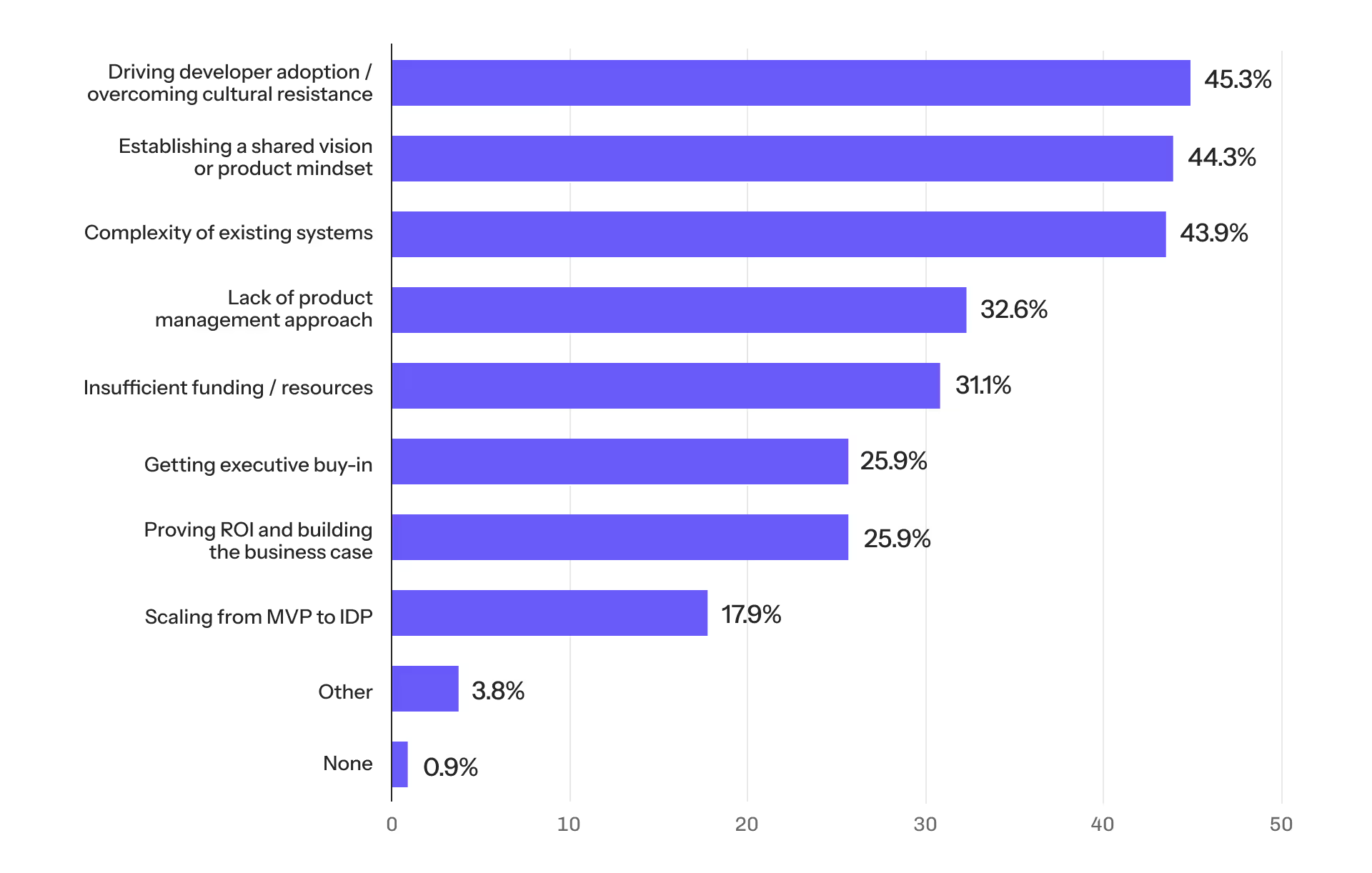
The hierarchy of challenges facing platform teams tells a clear story. Cultural and organizational barriers dominate:
- 45.3% struggle with driving developer adoption
- 44.3% lack a shared vision or product mindset
- 43.9% face complexity in existing systems
- 32.6% lack a product management approach
- 31.1% cite insufficient funding or resources
Technical complexity ranks third, not first. This proves platform engineering is fundamentally a sociotechnical challenge.
The data also reveals a resource constraint crisis. 47.4% of platform initiatives operate on budgets under $1M while expected to deliver broad organizational impact. Meanwhile, nearly 30% don't measure success at all, limiting their ability to demonstrate ROI and secure continued investment.
Challenge #1: Driving developer adoption (45.3% of teams)
Developers are customers with choices. They can bypass your platform, ignore your golden paths, or actively campaign against adoption. At the same time, most teams fall into the "perfection loop" trap. They attempt to solve every conceivable technical problem upfront, aiming for a platform that serves 100% of organizational needs. This perfectionism kills adoption as multi-year projects fail to demonstrate value quickly, leading to lost sponsorship and funding.
There are teams succeeding however, and those are the ones who embrace the MVP approach. Their Minimum Viable Platforms demonstrate value in weeks, not months. As Luca Galante puts it: "Perfect platforms do not exist; useful platforms exist. If you go too big too fast, you will fail."
Here's they are building adoption momentum:
- Identify pioneering teams: Find early adopters with high business value or significant pain points. These teams become your first advocates.
- Use Bottom-Up-Top-Down (BUTD) strategy: Win over platform customers at the ground level first. Build "first fans" by focusing intensely on their specific pain points and proving tangible improvements with metrics.
- Frame it as change management: Platform adoption is 20% technology, 80% change management. Platform teams must become adept at internal marketing and sales - or bring in experts who understand these concepts.
Mallory Haigh's "platform therapist" approach, used successfully at dozens of enterprises, emphasizes listening to actual workflows and understanding daily struggles rather than building in a vacuum. True customer discovery asks: "What job is the developer trying to accomplish?" and "Where do developers get stuck?"
Challenge #2: Establishing shared vision and product mindset (44.3% of teams)
The "listening too closely" trap catches many platform teams. They interview developers, build exactly what was requested, then face zero adoption. Why? Because user research isn't about building what developers ask for - it's about identifying pain points and solving them at a higher abstraction level.
Remember Henry Ford's line: "If I'd asked customers what they wanted, they would have told me, 'A faster horse!'"
The data shows varied approaches to product thinking:
- 38% have no dedicated Platform Product Managers but engineers operate with product mindset
- 25.4% lack product mindset entirely
- 21.6% have dedicated Platform Product Managers
- 15% combine PPMs with product-minded engineers
There's no single right answer across all orgs, but the 25.4% without any product orientation face a critical gap. Product thinking is non-negotiable for platform success.
Addressing the PPM talent shortage: Most companies hesitate to allocate their best product managers to platform work, treating it as a cost center rather than strategic investment. Solutions include upskilling engineers through programs like the Platform Engineering Practitioner certification as a first step or bringing in fractional PM support.
The key insight: focus on pain points, not feature requests. Build solutions that address underlying problems rather than implementing a wishlist of tools.
Challenge #3: Managing system complexity while providing simple abstractions (43.9% of teams)
Modernizing fragmented architectures while maintaining simplicity for developers creates a fundamental tension. Many teams fall into the "portal trap", starting with a developer portal UI while neglecting the deeper orchestration and automation required for real impact.
Build the house first, then the front door. The updated Internal Developer Platform reference architecture emphasizes a three-tier approach where you start from the backend with solid platform logic, rather than a presentation layer on the front end.
The build vs. buy decision framework matters a lot here. The best-performing platform engineering teams blend open source with commercial offerings rather than building everything from scratch. Consider:
- Do you have internal talent to build and maintain this component?
- How critical is customization to your business model?
- Can you afford to wait 6+ months for tangible outcomes?
- What's the Total Cost of Ownership, including opportunity costs?
Every sprint spent building your platform could mean features you don't ship to customers. Platform teams should enable delivery, not distract from it. Strategic buying can also accelerate your MVP and prove value faster, securing increased budget.
Challenge #4: Securing executive buy-in and proving ROI (25.9% of teams each)
Without strong leadership support, even brilliantly architected platforms become "expensive monuments to engineering excellence that deliver zero business value." The absence of executive buy-in leads to underfunding, scattered initiatives, and team burnout.
Contrast the failure scenario with SIXT's transformation: from 2 deployments per month in 2015 to 112,000 deployments in 2024 with 100% platform adoption. This was only possible because leadership understood and consistently supported the long-term value.
The minimal buy-in trap is worse than outright cancellation. When executives haven't pulled funding but aren't excited, platform teams drown in TicketOps, build unaligned initiatives, spend millions on unused developer portals, and eventually burn out. Good engineers, frustrated by lack of progress, inevitable quit, and the whole initiative comes crumbling down.
Frame platform benefits as business outcomes, not technical achievements. Instead of "we deployed a Kubernetes operator," say "we reduced on-call incidents by 60%."
Speak your executives language:
- CFO cares about: 60% reduction in on-call incidents, cost savings, avoided contractor expenses
- VP Engineering cares about: 5-minute deployments, developer retention, reduced time-to-market
- CISO cares about: Automated security guardrails, compliance automation, risk reduction
Build the business case with ROI calculations. Use concrete scenarios:
- Onboarding optimization: Show expected savings from better onboarding and standardization
- Retention at scale: Demonstrate DevEx improvements and avoided rehiring costs
- Startup approach: Emphasize lightweight, part-time platform teams that grow with the organization
Start with an MVP to prove value quickly. Don't ask for multi-year, multi-million investments upfront. Demonstrate measurable improvements and use those results to build the business case for scaling up.
Challenge #5: Measurement and feedback gaps (29.6% don't measure)
Nearly 30% of platform teams don't measure success at all. This represents improvement from last year's 45%, but the remaining gap is a critical vulnerability. Without measurement, you can't demonstrate value, guide investment decisions, or refine platform capabilities.
When asked about impact, 26.3% report significant improvement and 35.2% slight improvement - but 24.2% don't know if metrics have improved, and 13.6% see no change. This disconnect reveals that even teams with platforms often can't articulate their impact. This is a death sentence for your platform engineering initiative.
Measurement starter kit:
- DORA metrics (40.8% use): Deployment frequency, lead time, change failure rate, time to restore
- Tracking Time to Market (31.0% use): How quickly can teams ship features?
- SPACE framework (14.1% use): Satisfaction, Performance, Activity, Communication, Efficiency
Feedback collection methods show similar maturity gaps. Most teams rely on ad hoc conversations (32.4%) or feedback sessions (26.8%). Only 8% use built-in telemetry and usage analytics, despite their scalability advantages.
Recommended approach: Start with office hours and surveys for high-touch, qualitative feedback. Invest in telemetry for scale as your platform matures. If you're not collecting feedback at all, you're flying blind and likely building the wrong things.
Overcoming these challenges: A community-driven approach
These challenges aren't isolated problems, they're industry-wide patterns requiring systematic solutions. The good news is that you don't have to solve them alone.
The Platform Engineering community provides ongoing support through multiple channels:
- 90+ ambassadors actively publish research and share lessons learned
- 270,000+ community members exchanging practical insights and best practices
- Educational offerings including certification programs for practitioners, professionals, leaders, and architects
- Training and advisory services for hands-on support from MVP to full production scale
“Platform engineering is the bridge between ambition and execution - where developer productivity meets operational control and efficiency in a standardized way. Platforms make innovation repeatable - so teams can ship boldly without compromising governance and reliability. Broadcom is excited to exclusively sponsor the 2025 State of Platform Engineering Volume 4 report, amplifying proven strategies that turn platform vision into measurable outcomes.” — Pankaj Gupta, Senior Director, Broadcom.
Download the State of Platform Engineering Vol 4 for comprehensive data, case studies, and detailed insights into how successful teams overcome these challenges.