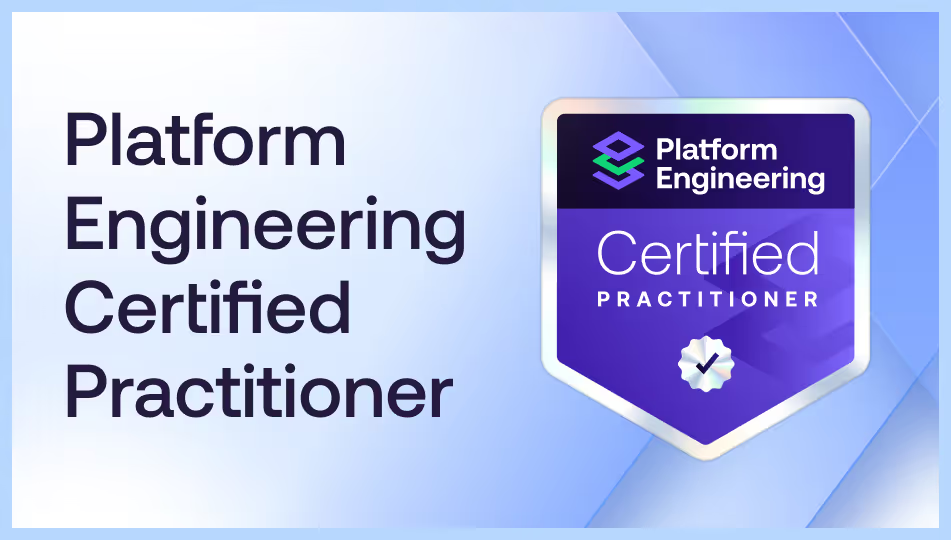

Platform engineering certifications aren't just about individual career advancement anymore. When NIIT partnered with Kyndryl to certify over 100 platform engineers, they demonstrated something more valuable: team-scale certification helps establish a shared language that addresses common communication breakdowns in platform initiatives. NIT transformed Kyndryl's distributed workforce, proving why training providers should pay attention to the $50 billion market opportunity unfolding right now.
Why platform engineering skills matter now
Platform engineering has shifted from being a niche DevOps evolution to becoming the strategic backbone of enterprise software delivery. Analyst forecasts project the platform engineering tools and services market to surpass $50 billion by 2028, driven by enterprise demand for scalability, developer experience, and operational efficiency.
The rapid adoption of internal developer platforms (IDPs) has created a critical skills gap. Organizations need engineers who can go beyond automation. They need professionals who understand abstraction layers, golden paths, and platform-as-a-product thinking. These are strategic disciplines that shape how technology teams work and deliver value.
Enterprises like Kyndryl are addressing this gap by certifying their consultants in platform engineering while turning best practices into a shared playbook that makes delivery more consistent and platform engineering repeatable across client accounts.
For resellers and training providers, this represents a clear growth opportunity. Platform engineering certifications are fast becoming the de facto standard for how high-performing organizations align their teams. Providers that offer these programs can tap into a fast-growing global market while helping enterprises future-proof their engineering capabilities.
About NIIT: More than training delivery
NIIT's designation as a Platform Engineering Certified Training Provider distinguishes them from traditional training vendors. This certification grants access to a global network of platform engineering practitioners, community-validated frameworks, and battle-tested best practices shaped by real-world implementations across the Platform Engineering community's 270,000+ members.
Certified provider status enables three critical capabilities:
- Community-validated curriculum - Training content reflects proven patterns from thousands of platform implementations, not theoretical frameworks
- Cultural transformation expertise - Guidance on organizational change, stakeholder alignment, and shared responsibility frameworks that determine platform success
- Practitioner network access - Direct connection to platform engineering leaders solving similar challenges across industries and geographies
This matters because platform engineering failures rarely stem from tool selection. Teams struggle because the cultural implications require reframing how organizations think about workflows, breaking down silos, and creating shared responsibility. NIIT brings the external perspective and change management guidance that internal teams lack.
Kyndryl's challenge: Scaling platform engineering across a global workforce
Kyndryl faced a specific problem: establishing shared language and standardized practices across 100+ engineers distributed globally. As a company serving diverse client technology stacks, they needed transferable platform engineering competencies, not vendor-specific training.
The challenge went beyond technical skills. The State of Platform Engineering report, gathering responses from nearly 500 practitioners, confirmed that shared language, platform-as-a-product adoption, and internal adoption struggles rank as the biggest challenges teams face. Kyndryl's distributed structure amplified these communication breakdowns.
Team-scale certification was chosen over individual training for a strategic reason: when entire teams complete the same course, they emerge with common vocabulary that improves every subsequent platform decision and discussion. Strategy discussions become more efficient. Documentation becomes more consistent. New team members onboard faster because concepts and terminology are standardized.
This approach mirrors successful implementations across the platform engineering community, where Heads of Platform validate content first, then enrol entire teams of 20-30 engineers to establish shared vocabulary simultaneously.
Community-validated, vendor-neutral competencies at scale: Certifying 100+ engineers
NIIT and Kyndryl's ability to certify 100+ engineers efficiently stemmed from the certification architecture's design: establishing universal foundational competencies before branching into specialized tracks matching individual roles within Kyndryl's platform organization.
The certification eco-system focuses on transferable principles rather than tool-specific skills.
For example, the Practitioner Certification five week curriculum covers:
- Abstraction layers - How platforms hide infrastructure complexity while maintaining flexibility
- Golden paths - Opinionated, well-supported workflows that guide developers toward best practices
- Platform-as-a-product thinking - Framing internal platforms as products with users, adoption metrics, and continuous improvement cycles
- MVP to IDP progression - The journey from Minimum Viable Platform to full Internal Developer Platform
This vendor-neutral approach was critical for Kyndryl. Rather than training engineers on specific toolchains, NIIT focused on competencies that apply across Kyndryl's diverse client environments. This meant emphasizing empathy-driven design, stakeholder communication strategies, and feedback loop implementation - the non-technical competencies that determine whether platforms achieve adoption or languish unused.
One participant described the transformation: "Over the past month, I've had the opportunity to dive deep into the world of platform engineering through the exceptional training offered by PlatformEngineering.org. I've completed the Practitioner class - earning a certification that not only validated my knowledge but also reshaped how I think about platform strategy, developer experience, and organizational enablement."
Another Kyndryl employee commented: "I completed the PE Certified Practitioner course and earned the related certification. The program offered insightful lectures, practical examples from our instructor Mallory Haigh and fellow participants, hands-on labs that fostered experiential learning, and a vibrant community of practitioners connected through Slack channels - greatly enriching the overall experience. If you haven’t yet embarked on a Platform Engineering journey - whether within your organization or independently—I highly recommend this course as a starting point."
Commonly reported outcomes from certified engineers and organizations include higher confidence in platform work, establishment of shared language across teams, faster execution on platform initiatives, and stronger internal alignment between previously siloed groups.
Why now is the time for training resellers
Re-selling Platform Engineering certifications isn't just transformative for enterprise customers - it's a scalable business opportunity for training providers globally.
The market dynamics are compelling. Platform engineering has moved from emerging practice to strategic priority, creating massive demand for standardized training. But most organizations lack internal expertise to develop curriculum or navigate the cultural transformation dimensions. This creates the perfect conditions for training resellers.
As a re-seller partner, you gain access to:
- Revenue opportunity. Tap into the $50 billion platform engineering market with proven, community-validated curriculum
- Inclusion in the Certified Training and Service Provider Directory
- Tried and tested frameworks, practitioner networks, and implementation patterns from 270,000+ community members
- Community recognition and co-branding opportunities within platformengineering.org and PlatformCon events
The competitive advantage goes to providers who move quickly. As platform engineering matures from ad-hoc infrastructure automation to structured, product-oriented practice, enterprises need partners who understand both the technical competencies and the cultural transformation dimensions. Certified service providers bring that dual expertise.
For training providers, the opportunity extends beyond one-time certifications. Platform engineering's rapid evolution creates ongoing demand for up-skilling. The Architect certification requires renewal after 12 months due to discipline changes. Specialized domain courses in Security Platform Engineering, Observability Platform Engineering, Data Platform Engineering, and AI are expanding monthly. This creates recurring revenue streams for providers who establish platform engineering training practices now.
👉 Get in touch to join the Reseller Program
Empower your customers. Build the next generation of platform teams. And help define the future of enterprise software delivery.
Join the Platform Engineering community and connect with peers on Slack.